WRITTEN ARTICLE · CRAFTING SELL PRICES
WoW Forever vendor shuffles: check crafting costs after the sell-price cuts
Crafted vendor prices have fallen in the Forever beta. Compare reported Blacksmithing prices and use a simple break-even check before spending your leveling gold.
Are vendor shuffles still worth doing?
A vendor shuffle means buying materials, crafting an item and selling it to an NPC for more than the materials cost. Blizzard’s October 15 notes say many profession items now sell for less. A shuffle that worked in an older build may therefore lose money today.
That does not prove every recipe is unprofitable. The useful question is whether the current sale value covers your actual costs. Check one craft before committing your leveling budget to a stack of materials.
In this article
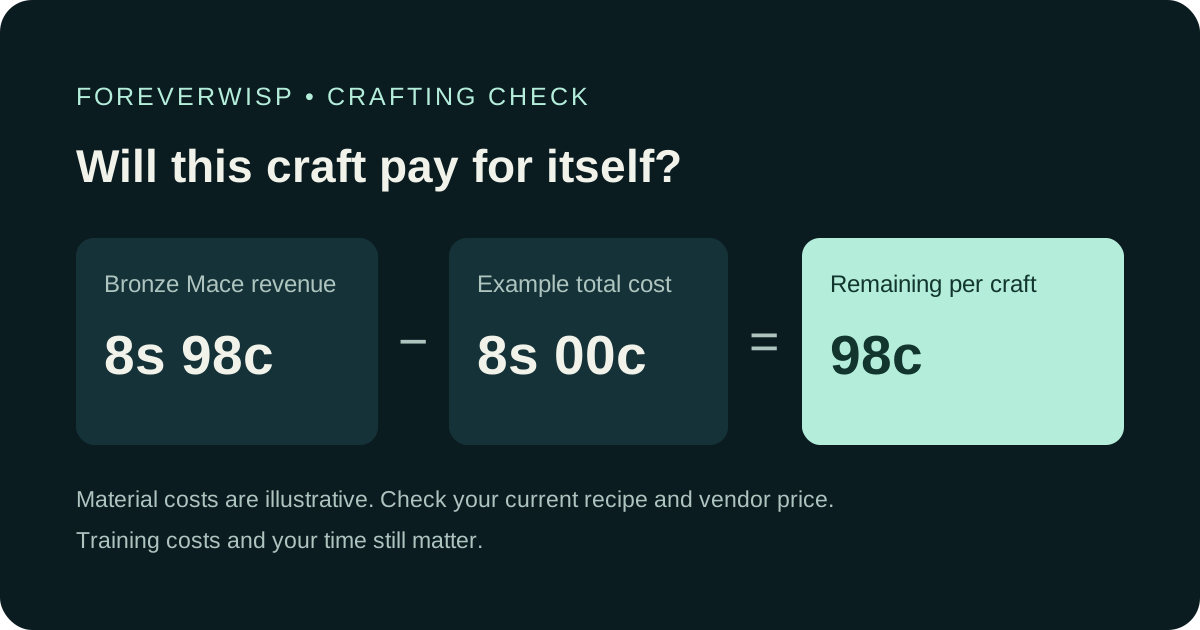
Original calculation graphic by ForeverWisp. Price source: Wowhead.
Examples from the Blacksmithing price changes
Wowhead’s comparison lists these reductions. Values are vendor sell prices, not Auction House prices.
| Crafted item | Previous sell price | Reported new sell price |
|---|---|---|
| Bronze Mace | 11s 19c | 8s 98c |
| Bronze Axe | 12s 69c | 9s 17c |
| Rough Bronze Leggings | 9s 62c | 5s 77c |
Work out the break-even price before crafting
Add up every material required for one finished item, including components bought from a vendor. Subtract that total from what the finished item sells for. Keep all the figures in copper while calculating so a silver conversion does not hide a small loss.
For example, take the reported Bronze Mace sale value of 898 copper. If your materials and vendor components cost 800 copper altogether, the difference is 98 copper. If they cost 950 copper, you lose 52 copper on each craft. Those costs are hypothetical examples, not prices from a particular server.
Training, recipe purchases and travel can make a small positive difference less attractive. If you are learning the recipe purely for this method, include the amount you need to earn back before calling it a profit.
| Example cost per craft | Sale value | Difference |
|---|---|---|
| 800 copper | 898 copper | 98 copper remaining |
| 898 copper | 898 copper | Break even before training and time |
| 950 copper | 898 copper | 52 copper loss |
Gathered materials are still a choice
Gathering your own ore avoids paying another player, but it does not make the materials worthless. You could use them for another recipe, save them for a skill milestone or sell them. Compare those options before turning an entire stack into vendor stock.
If the goal is profession skill rather than profit, a small loss might be acceptable. Write down that cost as a training expense. A recipe that buys you useful skill points and a recipe that generates spare gold are serving different purposes.
A safer routine for your next crafting stop
Check the current recipe, buy or gather a small batch, and confirm the actual sale value before scaling up. Keep enough gold aside for the next things your character needs. Do not let an old profit spreadsheet spend that reserve for you.
When planning professions alongside quests, group useful crafts around the materials you already expect to collect. That gives your profession stops a purpose even when a vendor shuffle no longer pays.
- Confirm the recipe’s output quantity before calculating a per-item cost.
- Count every reagent, not just the ore or cloth.
- Separate money earned from profession skill gained.
- Recheck after a beta update before repeating a large batch.
Related reading and guides
Sources and review notes
Reviewed October 17. Blizzard confirms reduced vendor prices and Wowhead provides the item comparisons. Calculations use illustrative material costs. We have not measured market prices, profit per hour or a best profession.